Why London Roofs Get Mossy and Black Faster Than Rural Roofs


If you've ever compared a roof in central London to one on a cottage out in the countryside, you've probably noticed something: the London roof looks tired far sooner. Black streaking, dark green moss patches, and grimy tile surfaces tend to show up years earlier on city roofs than on rural ones, even when both roofs are the same age and made from the same materials.
This isn't bad luck. It's a combination of pollution, shade, and damp that's built into city living, and understanding why it happens is the first step to managing it. Here's what's actually going on above London's rooftops.
Air Pollution Feeds Algae and Speeds Up Staining
London's air carries a heavier load of particulates, traffic emissions, and airborne grime than most rural areas. That pollution settles on roof surfaces constantly, creating a fine film that traps moisture and organic matter. Black staining on roof tiles is very often caused by gloeocapsa magma, a type of algae that thrives on exactly this kind of nutrient-rich, damp surface.
In cleaner rural air, tiles dry out faster and have less airborne material to feed on. In London, the combination of traffic pollution and residual moisture creates near-perfect conditions for algae and moss to establish themselves, and once they do, they spread quickly across the whole roof.
Dense Housing Means More Shade and Slower Drying
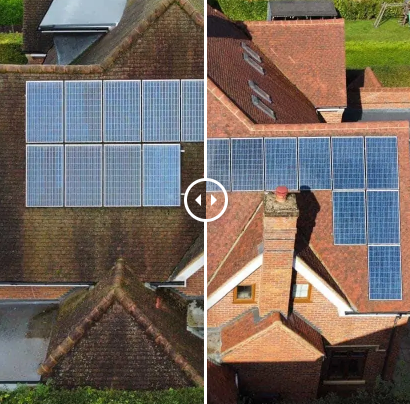
London's terraced streets, tightly packed semis, and tall surrounding buildings all create something rural roofs rarely deal with: constant partial shade. A roof that's shaded for large parts of the day never gets the chance to fully dry out after rain, even in decent weather.
Moss and algae need consistent moisture to establish and spread. On an open rural roof with full sun exposure, that moisture evaporates quickly. On a shaded London roof, damp can linger in the same patches for days, giving moss the exact conditions it needs to take hold, usually starting on the north-facing slope or the side closest to a neighbouring wall.
London's Damp Microclimate Doesn't Help
London sits in a natural bowl and tends to trap more humidity than surrounding areas, thanks to the urban heat island effect combined with the Thames and its tributaries running through the city. Combine that ambient dampness with pollution and shade, and you get a microclimate that's almost custom-built for moss growth.
Editor Note: Worth double-checking specific climate/humidity statistics for London vs national averages if we want to include hard figures, the general microclimate effect is well documented but exact numbers should be sourced. |
Older Housing Stock Plays a Role Too
A large share of London's housing was built well before the mid-20th century, Victorian and Edwardian terraces, in particular, are everywhere across the city. These older roofs often have more textured tile surfaces, more roof valleys and joints where debris collects, and, in some cases, decades of accumulated grime that gives algae spores something to grip onto in the first place.
Newer rural developments, by comparison, often have smoother modern tiles and simpler roof lines that shed water and debris more efficiently.
Why This Matters for House Roof Cleaning
None of this means London roofs are worse built, it means they're working in a tougher environment. That's why house roof cleaning in London tends to be a more frequent necessity in the city than in rural areas, and why a one-off clean rarely stays effective as long as it would elsewhere.
If you're comparing quotes from roof cleaning companies near me, it's worth asking specifically how they account for this. A softwash treatment that includes a biocide element will slow down regrowth far more effectively than a straightforward pressure rinse, which only removes what's visible without addressing the spores left behind.
Signs Your London Roof Needs Attention
• Dark streaking running down from the ridge or ends of tiles
• Green or black patches concentrated on shaded or north-facing slopes
• Moss visibly growing between tile joints or in valleys
• Gutters clogging more frequently with debris washed off the roof
• Neighbouring roofs on the same terrace showing similar staining
London vs Rural Roofs: What's Different
Factor | London Roofs | Rural Roofs |
Air quality | Higher pollution, more particulates settle on tiles | Cleaner air, less airborne grime |
Sun exposure | Frequent shade from dense housing and tall buildings | Fuller sun exposure, faster drying |
Moisture | Urban microclimate holds more ambient damp | Dries out more quickly after rain |
Housing age | Large share of older Victorian/Edwardian stock, more textured tiles | Mix of ages, often smoother modern tiles |
Cleaning frequency | Typically needed more often | Longer intervals between cleans |

Choosing the Right Roof Cleaning Company in London
Because of how quickly London roofs can redevelop moss and staining, the method matters as much as the price. A reliable roof cleaning company should be able to explain their approach, use a treatment suited to your specific roof type, and set realistic expectations about how long results will last given the conditions described above.
Look for roof cleaners who are insured, trade-accredited, and willing to put their process and any guarantee in writing, the same principles that apply anywhere in the UK, but especially relevant in a city where roofs are under more pressure than most.


Comments